
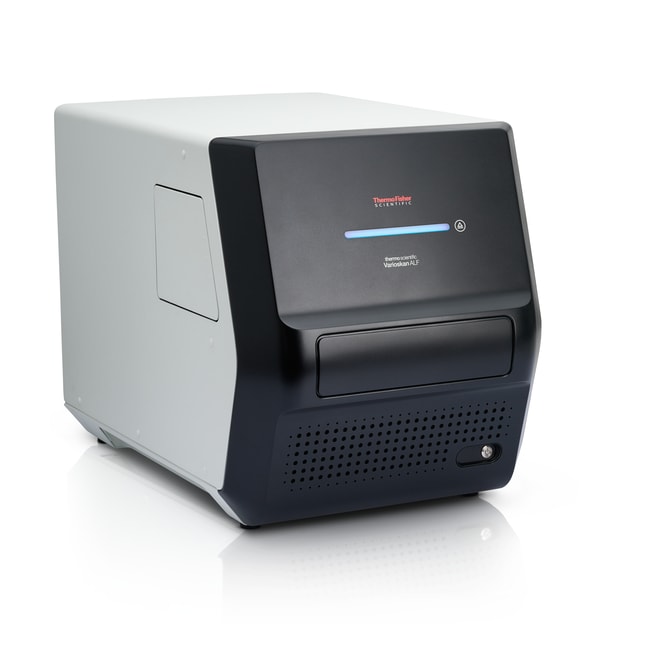
Varioskan ALF Multimode Microplate Reader
The Thermo Scientific Varioskan ALF Multimode Microplate Reader is a versatile, entry level reader for most common absorbance, turbidimetric, fluorescence, and luminescence microplate assays. Its photometric optical design is based on a xenon flash lamp and monochromator, enabling continuous wavelength selection from UV through visible range up to 1000 nm. The broad wavelength range enables many common assays, including nucleic acid and protein quantification, bacterial growth curves, ELISA, and cell viability.
Overview
Overview
The Thermo Scientific Varioskan ALF Multimode Microplate Reader is a versatile, entry level reader for most common absorbance, turbidimetric, fluorescence, and luminescence microplate assays. Its photometric optical design is based on a xenon flash lamp and monochromator, enabling continuous wavelength selection from UV through visible range up to 1000 nm. The broad wavelength range enables many common assays, including nucleic acid and protein quantification, bacterial growth curves, ELISA, and cell viability.
Enhance your fluorescence and luminescence measurements with the filter-based optics
With the Varioskan ALF reader, fluorescence and luminescence measurements are performed with filter-based optics for optimal specificity and sensitivity. The system comes with three pre-installed excitation and emission filter sets suitable for many common fluorometric applications like Quant-IT DNA quantitation assays and PrestoBlue and AlamarBlue cell viability assays. Additionally, five open filter positions are available for customized fluorometric and luminometric measurements. The filter slots are easy to access on the instrument’s side with no tools required for filter exchange. Also, commonly used FRET and BRET assays are easy to set up and perform thanks to Varioskan ALF reader’s unique filter-based optics design.
This package includes a Varioskan ALF Multimode Microplate Reader (Cat. No. VA000010C) and a Rapid Exchange two-year extended warranty.
Achieve consistently accurate results with automatic gain adjustment
The automatic gain adjustment feature selects the ideal fluorometric or luminometric reading range for your instrument based on signal intensity in the well, eliminating the need to manually adjust measurement parameters. The results are consistent no matter what signals are measured.
Additional features
- Kinetic and endpoint measurements for a variety of applications
- Spectral scanning for photometric measurements
- Separate optimized measurement modes for absorbance and turbidimetric measurements
- A self-diagnostics system that includes a set of initialization tests and adjustments, ensuring instrument readiness for operation
- Compatible with 6- to 384-well microplates with and without lids
- Reads μDrop and μDrop Duo plates for microvolume analysis of DNA, RNA, and proteins
- Performs onboard shaking and incubation for temperature-critical assays
- Operated through SkanIt softwareUnlimited installation on multiple computers, no annual fee requiredIncludes an extensive cloud-based library of ready-made protocolsTwo editions available: Research Edition for life sciences and Drug Discovery Edition with features for compliance with 21 CFR Part 11Multiple user interface languages availableAutomation compatibility for integration with automation interface
- Thermo Scientific verification plates provide comprehensive and traceable validation of the instrument optical performance. Ready-made SkanIt software protocols provide easy to read reports with defined measurement parameter limits
Varioskan ALF Multimode Microplate Reader with 2-year Extended Warranty (A66711), REX is a Varioskan ALF specific package SKU including the instrument (VA000010C), and an extended warranty to 2 years which includes a rapid exchange service (REX) should the instrument get broken during the warranty period.
For Research Use Only. Not for use in diagnostic procedures.
Varioskan ALF Multimode Microplate Reader
Versatile, entry-level multimode reader
The Thermo Scientific Varioskan ALF Microplate Reader is a versatile, plug and play, entry-level multimode system designed for researchers who need reliable multimode capability without added complexity. It supports absorbance, fluorescence, luminescence, and turbidimetric assays used across everyday life science research—helping researchers move from sample to results quickly and confidently. With intuitive SkanIt Software and hardware designed to support complete assay workflows, Varioskan ALF offers the right balance of simplicity and capability for labs that want efficient, reliable performance without unnecessary features.
Features
Simple to set up, easy to use
Guided workflows, application-focused configurations, and easy installation reduce setup decisions and training time, allowing researchers to focus on running assays and interpreting results.
Designed for the assays you rely on most
Multimode capability aligned to your assay needs including nucleic acid and protein quantitation, ELISA, cell proliferation and viability assays, functional assays, endotoxin testing, bacterial growth curves, and more.
Simple software with unlimited licenses
SkanIt Software offers ready-to-use protocols which include calculations combined with streamlined data acquisition and analysis to enable an efficient workflow. Unlimited installations with no annual software fees make it easy to deploy across labs without added software friction.
Supports complete workflows for critical assays
Onboard shaking and incubation support temperature-critical assays by maintaining consistent experimental conditions, while a xenon flash lamp complements these workflows with UV-Vis absorbance and fluorescence measurements providing broader capability and longer service life than halogen-based systems.
Frequently asked questions
Can relative fluorescence units (RFUs) be compared between two different plate readers?
Relative fluorescence units (RFUs) cannot be compared between two different microplate readers. RFU values are arbitrary and dimensionless, meaning that the actual numbers don’t have a specific physical meaning, but the relative values are used for comparison. The critical measurement is the ratio of signal to background.
Whether the signal is low or high is 100% dependent on the baseline, i.e., if the sample signal is 2 and the baseline is 1, then it is a low signal but if the sample signal is 2 and the baseline is 0.01, then it is a very high signal. Instruments that typically give sample signals in the tens of thousands RFUs also typically have baseline RFUs somewhere in the tens or hundreds. For example, the Varioskan Microplate Reader is designed such that the baseline is kept below 0.1 RFU.
Specifications
Varioskan™ ALF Multimode Microplate Reader (Cat. No. VA000010C)
| Absorbance Range | 200 to 1000 nm |
|---|---|
| Accuracy (Photometric) | ±1.0% + 0.003 Abs (0 to 2 Abs), ±2.0% (2.0 to 2.5 Abs) at 450 nm (96-well plate) |
| Bandwidth | Photometry: 2.5 nm |
| Cuvettes | No |
| Depth (Metric) | 61 cm |
| Detector Type | Photomultiplier Tube (PMT) |
| Dimensions (L x W x H) | 61 x 34 x 40 cm |
| Dynamic Range | Fluorometry and Luminometry: ≥6 Decades |
| Emission Wavelength Range | 210-720 nm |
| Excitation Wavelength Range | 200-710 nm |
| Filters | Three factory installed fluorometric filter pairs: Coumarin family (Excitation 345/25 nm, Emission 450/40 nm); Fluorescein family (Excitation 485/15 nm, Emission 525/15 nm); Resorufin family (Excitation 555/15 nm, Emission 615/45 nm) |
| For Use With (Application) | Photometric, fluorometric and luminometric microplate assays |
| Height (Metric) | 40 cm |
| Includes | SkanIt Software, Research Edition |
| Incubator Temperature | Ambient +2° to 45°C |
| Interface | PC Software (Thermo Scientific SkanIt Software) |
| Light Source | Xenon Flash Lamp |
| Linearity | 0 to 2.5 Abs, 2.0% at 450 nm (96-well plate) |
| Measurement Speed | Photometry: ≤10 sec. (fast mode); Fluorometry and Luminometry: ≤20 sec. (96-well plate) |
| Precision | SD <0.003 Abs, or CV <1.0% at 450 nm |
| Product Line | Varioskan |
| Product Type | Multimode Microplate Reader |
| Quantity | Microplate Reader + 1 year warranty |
| Reading Options | Endpoint |
| Sensitivity | Photometry (DNA): <1 ng/μL (96-well half area plate); Turbidimetry (formazin): <5 turbidity units (FTUs) (96-well plate); Fluorometry (fluorescein): 0.35 fmol/well (black 384-well plate); Luminometry (ATP): <275 amol/well (white 96-well plate) |
| Shaking | Double Orbital |
| Software Language Versions | English, French, German, Spanish, Portuguese, Italian, Japanese, Chinese |
| Software Type | SkanIt Software |
| Spectral Scanning Speed | ≤16 sec. (Fast mode) |
| Unit Size | 1 each |
| Voltage | 100/115/220/230 V |
| Warranty | 1-year Standard |
| Weight (Metric) | 24.5 kg |
| Width (Metric) | 34 cm |
Varioskan ALF Multimode Microplate Reader – specifications
| Category | Attribute | Description |
|---|---|---|
| Absorbance | Light source | Xenon flash lamp |
| Wavelength selection | Monochromator | |
| Wavelength range | 200–1,000 nm | |
| Bandwidth | 2.5 nm | |
| Wavelength setting resolution | 1 nm | |
| Wavelength accuracy | ±2 nm | |
| Stray light, @230 nm | <0.05% | |
| Linearity (absorbance), @450 nm | 96-well plate: 0–2.5 Abs, 2.0% | |
| Accuracy (absorbance), @450 nm | 96-well plate: For 0–2.0 Abs: ±(1.0% + 0.003 Abs) For 2.0–2.5 Abs: ±2.0% | |
| Precision (absorbance), @450 nm | SD <0.003 Abs or CV <1.0%, whichever is greater | |
| DNA sensitivity @260 nm* | 96-well half area plate: <1 ng/μL | |
| Turbidimetric sensitivity* | 96-well plate: <5 formazin turbidity units (FTUs) | |
| Measurement speed** | 96-well plates Fast mode: ≤10 seconds Precision mode: ≤26 seconds | |
| Spectral scanning speed | Fast mode: ≤16 seconds from 200–1,000 nm with 1 nm steps | |
| Precision mode: ≤200 seconds from 200–1,000 nm with 1 nm steps | ||
| Fluorescence intensity | Dynamic range | ≥6 decades |
| Sensitivity* | Black 384-well plate: 0.35 fmol/well FITC | |
| Wavelength | Excitation wavelength: 200–710 nm Emission wavelength: 210–720 nm | |
| Wavelength selection | Filter wheels with three factory filter pairs and five optional filter positions | |
| Factory installed filter pairs [wavelength (nm)/FWHM†(nm)] | Coumarin family filter pair Excitation 345/25 Emission 450/40 | |
| FITC family filter pair Excitation 485/15 Emission 525/15 | ||
| Resorufin family filter pair Excitation 555/15 Emission 615/45 | ||
| Dual label measurements speed | <1 second | |
| Measurement speed, fixed dynamic range** | 96-well plates: ≤20 seconds | |
| Measurement time | 10–1,000 ms | |
| Luminescence | Wavelength selection | Five optional filter positions |
| Wavelength range | 200–720 nm | |
| Dynamic range | ˃6 decades | |
| Sensitivity* | White 96-well plate: <275 amol/well ATP | |
| Crosstalk (96-well white plate) | White 96-well plate: ≤0.1% | |
| Measurement speed, fixed dynamic range** | 96-well plates: ≤20 seconds | |
| Measurement time | 10 ms to 10 seconds | |
| Incubator | Temperature range | From ambient +2°C to 45°C (room temperature 25°C) |
| Liquid warm-up time | 96-well plate, 200 μL water/well: <60 minutes from 25°C to 37°C | |
| Mean temperature of wells at 37°C | ±0.5°C | |
| Plate temperature uniformity at 37°C | <1.0°C | |
| Shaker | Shaking modes | Linear, orbital, dual orbital |
| Shaking speeds | Low, medium, high | |
| Shaking type | Continuous or pulsed | |
| General features | Measurements modes | Endpoint, kinetic, spectra, kinetic spectra |
| Interface | PC software (SkanIt Software) | |
| Dimensions (D x W x H) | 61 x 34 x 40 cm (24 x 14 x 16 in) | |
| Weight | 25 kg (55 lbs) |
Documents
- PDF Brochure: The Complete Guide to Thermo Scientific Microplate Readers and Assays
- PDF Brochure: SkanIt Software 7.0 for Microplate Readers
- PDF Flyer: Nunc Plate Selection Table for Plate Readers
- PDF Specification Sheet: Varioskan ALF Multimode Microplate Reader
- PDF Technical Guide: Varioskan ALF Multimode Microplate Reader
- PDF User Guide: Varioskan ALF Multimode Microplate Reader
Videos
Product information, images, documents and videos: Thermo Fisher Scientific. View on manufacturer website Source 2