
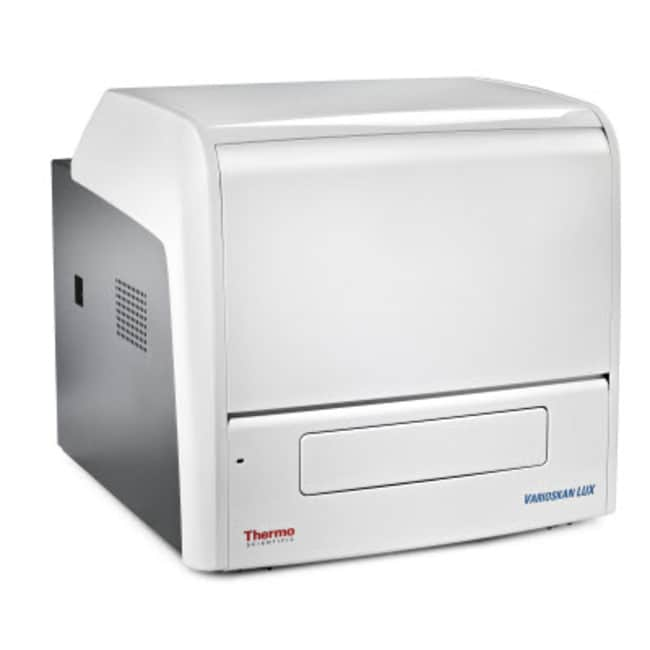
Varioskan LUX Multimode Microplate Reader
Analyze a variety of samples with five measurement technologies, including absorbance (UV-Vis), fluorescence intensity, Luminescence, AlphaScreen / AlphaLISA and TRF.
Overview
Overview
Analyze a variety of samples with five measurement technologies, including absorbance (UV-Vis), fluorescence intensity, Luminescence, AlphaScreen / AlphaLISA and TRF.
Designed for bioscience researchers with a wide variety of needs, the Thermo Scientific™ Varioskan™ LUX multimode microplate reader comes equipped with a flexible range of measurement technologies including Absorbance, Fluorescence Intensity, Luminescence, AlphaScreen, and Time-Resolved Fluorescence. The instrument simplifies measurement setup with the automatic dynamic range selection, and its smart safety controls ease workflow and help avoid experimental errors. Varioskan LUX raises the bar for reliability and ease, with technology that works in researchers’ best interest.
The Varioskan LUX multimode reader has received HTRF™ certification from Cisbio Bioassays and DLReady™ validation from Promega Corporation.
The Varioskan LUX is a modular, upgradable instrument that provides excellent usability across a variety of applications.
- Up to five measurement technologies: Absorbance (UV-Vis), Fluorescence intensity (incl. FRET), Luminescence (direct and filtered), AlphaScreen/AlphaLISA and Time-resolved fluorescence (incl. TR-FRET/hTRF)
- Filter and monochromator optics
- Spectral scanning for assay optimization
- Five measurement modes including end point, kinetic, spectra, kinetic spectra and multipoint
- Integrated gas control module for setting CO2 and O2 concentrations for cell based assays
- Simultaneous dispensing and measurement for signal monitoring at the start of a reaction
- Automatic dynamic range selection, based on signal intensity of each well
- Smart safety controls designed to identify and alert the user of potential problems before they happen
- Automated instrument calibration and self-diagnostics for reliable performance
- Certified HTRF compatible reader by CisBio Bioassays
- Validated DLReady by Promega Corporation
Varioskan LUX is paired with the powerful and intuitive SkanIt Software, providing excellent usability and flexibility.
- License free—Each user can install the software on his/her computer
- Intuitive and flexible interface for multiple users and assays
- Innovative Virtual Pipetting Tool makes it easy to define samples to plate layout
- Measurement data is continuously saved to the database, so there’s no data lost due to unexpected interruptions such as power outages or accidental aborting
- Simplified data processing and exportExport data in a single mouse click, or have it emailed automatically at the end of the runSeveral file formats for exporting results: *.xlsx, *.pdf, *.xml, and *.txt
- Shows real-time spectra and kinetic curves during the measurement
- Built-in calculations for data analysis (e.g. blank subtraction, average/SD/CV%, standard curve, dose response, quality control, classification, kinetic and spectral analysis, custom formula, etc.)
- Comprehensive result reports with traceability to runtime actions and settings
- Two editions available: Research Edition for life science researchers, and Drug Discovery Edition which offers features needed for the FDA 21 CFR Part 11 compliance.
The Varioskan LUX is modular and upgradeable, so you can build the system that best suits your needs. For more information, contact a sales representative.
Varioskan LUX Multimode Microplate Reader
Advanced multimode reader with up to 5 detection modes
The Thermo Scientific Varioskan LUX Multimode Microplate Reader is designed to help deliver results you can trust across a wide range of assays, with minimal setup and optimization. Built for laboratories with diverse and evolving needs, it combines high-performance detection with intelligent automation to help reduce setup time, minimize errors, and support reliable first-read results. Features such as automated dynamic range selection and built-in safety checks adapt measurements to signal intensity and help prevent common experimental issues before a run begins. Flexible hardware options and efficient software integration allow capabilities to be expanded over time, so that the system may grow with your research rather than limiting it.
Core capabilities
- Absorbance
- Fluorescence
- Luminescence
- Top and bottom reading
Optional add-ons
- Dual dispenser*
- Gas control
- Advanced detection modes (AlphaScreen & time-resolved fluorescence)*
Features
Confidence across low- and high-intensity signals
Automatic dynamic range selection adjusts the reading range based on signal intensity in each well, allowing low and high signals to be measured accurately in a single run while reducing manual optimization and the risk of saturation.
Fewer errors and more reliable first-read results
Smart safety controls help identify potential issues before a measurement begins, reducing common setup and runtime errors and helping protect valuable samples.
A system that grows with your research
Modular and upgradeable design allows the Varioskan LUX to be configured for current needs and expanded over time. Optional hardware upgrades are supported within SkanIt Software, enabling new functionality without disrupting existing workflows or retraining users.
Flexibility for diverse assay requirements
Offers assay flexibility by pairing monochromator-based wavelength selection for absorbance and fluorescence intensity with filter-based optics that help ensure higher sensitivity and specificity for luminescence, time-resolved fluorescence, and AlphaScreen assays.
Frequently asked questions
In the Varioskan LUX Multimode Microplate Reader, how is running a TRF spectrum by setting excitation at 335 nm and using emission range different from running a filter-based TRF assay? Why does SkanIT Software have the TRF spectrum option?
The TRF spectrum option is useful for spectral analysis, assay and label development, and optimization purpose. For example, when a new TRF chelate label is developed, TRF spectrum measurement can be used to analyze the spectra when a lot of label is loaded in the well.
When the TRF spectrum option is used, the sensitivity is not sufficient for actual TRF assays as the instrument sensitivity decreases by about 200-fold. Hence, the TRF spectrum option should not be used for normal TRF assay applications. For optimal results, the TRF spectrum option should be used for TRF spectral scanning but not for running actual TRF assays. Actual TRF assays must be performed using filter-based TRF optics in the LAT module.
If the Varioskan unit does not have TRF optics in the LAT module, TRF spectral scanning cannot be performed. In this case, TRF spectral scanning can only be performed using TRF-based filters.
Find additional tips, troubleshooting help, and resources within our Cell Analysis Support Center.
How to remove a stuck microplate from the Varioskan LUX Multimode Microplate Reader
Power off the Varioskan LUX instrument, open the sliding door, and then press both springs outward (1) to unlock the bottom of the front panel. Tilt the bottom of the panel outwards slightly and lift up to remove.
Look inside the instrument to locate the tray (3). Gently slide the tray to the left and then towards you to access the plate. Check for jams and make sure that the correct holder is installed. When finished, push the tray back into the instrument (exact position doesn’t matter as long as it is completely inside) and reinstall the front panel.
Note: Remove the bottom front cover on the instrument, in order to access the plate carrier, and manually pull out the plate. Do not attempt to grab the plate back through the plate door, otherwise it can cause alignment issues that will require a repair.
Find additional tips, troubleshooting help, and resources within our Cell Analysis Support Center.
Can relative fluorescence units (RFUs) be compared between two different plate readers?
Relative fluorescence units (RFUs) cannot be compared between two different microplate readers. RFU values are arbitrary and dimensionless, meaning that the actual numbers don’t have a specific physical meaning, but the relative values are used for comparison. The critical measurement is the ratio of signal to background.
Whether the signal is low or high is 100% dependent on the baseline, i.e., if the sample signal is 2 and the baseline is 1, then it is a low signal but if the sample signal is 2 and the baseline is 0.01, then it is a very high signal. Instruments that typically give sample signals in the tens of thousands RFUs also typically have baseline RFUs somewhere in the tens or hundreds. For example, the Varioskan Microplate Reader is designed such that the baseline is kept below 0.1 RFU.
How can I move the Varioskan LUX Multimode Microplate Reader from one place to another?
We recommend transporting the Varioskan LUX Multimode Microplate Reader in the original packaging it was delivered in, with proper padding in the box, and after securing the tray holder transport lock on the instrument. See page 84 of the user manual for instructions to refit the transport lock of the tray holder.
Note: We also offer a service to move the instrument. Please reach out to serviceproducts@thermofisher.com.
Which is the best DNA or RNA quantification instrument?
All of the DNA instruments offered by Thermo Fisher Scientific are of excellent quality. To find the right instrument to quantify DNA or RNA in your lab, explore the detailed comparison of UV-Vis spectrophotometers and fluorometers. Things like sensitivity, throughput and budget may be initial considerations when selecting a DNA quantification instrument. You may also consider whether you need target specificity, sample purity information, RNA quality information, or broad dynamic range.
Find additional tips, troubleshooting help, and resources within our Nucleic Acid Quantification Support Center.
Specifications
Varioskan™ LUX Multimode Microplate Reader (Cat. No. VLBL00GD2)
| Accuracy (Photometric) | 0.003 Abs or ±2% at 200 to 399 nm (0 to 2 Abs), 0.003 Abs or ±1%, at 400 to 1000 nm (0 to 3 Abs) |
|---|---|
| CO2 Concentration Range | 0.1 to 15% |
| Compatibility | Automation |
| Depth (English) | 23 in. |
| Depth (Metric) | 58 cm |
| Detector Type | Photomultiplier Tube (PMT) |
| Dimensions (L x W x H) | 58 x 53 x 51 cm (23 x 21 x 20 in.) |
| Dispense Volume | 2 to 5000 μL with 1 μL increments |
| Dynamic Range | Fluorescence intensity: top reading > 6 decades; Luminescence: > 7 decades |
| Emission Filters | Available for purchase |
| Height (English) | 20 in. |
| Height (Metric) | 51 cm |
| Includes | Gas Module, SkanIt PC Software, Research Edition |
| Incubator Temperature | Ambient +4° to 45°C |
| Interface | PC Software (Thermo Scientific SkanIt Software) |
| Light Source | Xenon Flash Lamp |
| Linearity | 96-well plate: 0 to 4 Abs, ±2% at 450 nm, 384-well plate: 0 to 3 Abs ±2% at 450 nm |
| Measurement Speed | 15 sec. for 96-well Plate, 45 sec. for 384-well Plate, 135 sec. for 1536-Well Plate (Minimum Times) |
| Measurement Technology | Absorbance |
| Measurement Type | Endpoint, Kinetic, Spectra, Multipoint, Kinetic Spectra |
| No. of Dispensers | 2 |
| O2 Concentration Range | 1 to 21% |
| Plate Type | 6 to 1536-well Plates (Absorbance 6 to 384-well Plates), μDrop Plates |
| Precision | SD <0.001 Abs or CV <0.5%, at 450 nm (0 to 3 Abs) |
| Product Line | Varioskan |
| Read-out Range | 0 to 6 Abs |
| Reading Options | Top |
| Sensitivity | Fluorescence intensity (top reading): <0.4 fmol fluorescein/well (black 384-well plate), Luminescence: <7 amol ATP/well (white 384-well plate) |
| Shaking | Orbital |
| Software Language Versions | English, German, French, Spanish, Portuguese, Italian, Japansese, Chinese |
| Software Type | SkanIt Software |
| Spectral Scanning Speed | <2.2 sec./Well 400 to 500 nm, 1 Flash, 2 nm Step |
| Unit Size | Each |
| Wavelength Range | Absorbance: 200-1000 nm; Fluorescence intensity: Excitation: 200-822 nm, Emission: 270-840 nm; Luminescence: 360-670 nm |
| Wavelength Selection | Dual Monochromators (Abs) |
| Weight (English) | 125 lb. |
| Weight (Metric) | 57 kg |
| Width (English) | 21 in. |
| Width (Metric) | 53 cm |
Varioskan LUX Multimode Microplate Reader – specifications
| Category | Attribute | Description |
|---|---|---|
| Absorbance | Plate types | 6–384 well plates |
| Wavelength selection | Double monochromators | |
| Wavelength range | 200–1,000 nm | |
| Light source | Xenon flash lamp | |
| Linear measurement range | 0–4 Abs (96-well plate) at 450 nm, ± 2% 0–3 Abs (384-well plate) at 450 nm, ± 2% | |
| Accuracy | 0.003 Abs or ± 2%, at 200–399 nm (0–2 Abs) 0.003 Abs or ± 1%, at 400–1,000 nm (0–3 Abs) | |
| Precision | SD <0.001 Abs or CV <0.5%, at 450 nm (0–3 Abs) | |
| Fluorescence intensity | Plate types | 6–1536-well plates (top reading) 6–384-well plates (bottom reading) |
| Wavelength selection | Double excitation and emission monochromators | |
| Excitation wavelength range | 200–822 nm | |
| Emission wavelength range | 270–840 nm | |
| Light source | Xenon flash lamp | |
| Sensitivity | Top reading: <0.4 fmol fluorescein/well (black 384-well plate) Bottom reading: <4 fmol fluorescein/well, (clear bottom black 384 square well plate) | |
| Dynamic range | Top reading >6 decades Bottom reading >5.5 decades | |
| Time-resolved fluorescence | Plate types | 6–1,536 well plates |
| Wavelength selection | Filters (spectral scanning with double excitation and emission monochromators) | |
| Excitation wavelength range | Fixed to 334 nm (spectral scanning 200–840 nm) | |
| Emission wavelength range | 400–670 nm (spectral scanning 270–840 nm) | |
| Light source | Xenon flash lamp | |
| Sensitivity | <1 amol Eu/well (white low volume 384 well plate) | |
| Dynamic range | >6 decades | |
| Luminescence | Plate types | 6–1536 well plates (spectral scanning 6-384 well plates) |
| Wavelength selection | Direct or filters (spectral scanning with double monochromators) | |
| Wavelength range | 360–670 nm | |
| Sensitivity | <7 amol ATP/well (white 384-well plate) | |
| Dynamic range | >7 decades | |
| Alpha | Plate types | 6–1536 well plates |
| Wavelength selection | Filters | |
| Excitation wavelength range | Fixed to 680 nm | |
| Emission wavelength range | 400–660 nm | |
| Light source | LED | |
| Sensitivity | <100 amol phosphotyrosine/well (white 384-well plate) | |
| Dispensing | Plate types | 6–384 well plates |
| No. of dispensers | None or two | |
| Syringe size | 1 mL | |
| Dispensing volume | 2–5,000 μL, in 1 µL increments | |
| Accuracy | <1 μL with 50 μL | |
| Precision | <1 μL with 50 μL | |
| Dead volume | Reagent loss <100 μL, Total tubing volume <800 μL | |
| Incubator and shaker | Temperature range | From ambient + 4 °C to 45 °C |
| Shaking type | Orbital | |
| Integrated gas module | Measurement chamber O2 concentration accuracy | ±1.0% (37 °C, 1% O2) |
| Measurement chamber CO2 concentration accuracy | ±1.0%. (37 °C, 5% CO2) | |
| Measurement chamber O2 concentration | 1–21% | |
| Measurement chamber CO2 concentration | 0.1–15% | |
| Gas concentration recovery time | 10 minutes | |
| General features | Measurement modes | Endpoint, kinetic, spectra, multipoint and kinetic spectra |
| Measurement speed | Reads a 96-well plate in 15 s, a 384-well plate in 45 s, and a 1,536-well plate in 135 s (minimum times) | |
| Interface | PC software (SkanIt software) | |
| Dimensions (D x W x H) | 58 x 53 x 51 cm (23 x 21 x 20 in) | |
| Weight | 53–60 kg, (117-132 lb), depending on configuration |
Documents
- PDF Brochure: Varioskan LUX Multimode Microplate Reader
- PDF How can built-in smart safety controls help avoid errors in microplate assay experiments?
- PDF How will automatic dynamic range selection ease workflow and improve the outcome of my microplate as
- PDF user manual
- PDF Application Note: A rapid, fully automatable bead-based SARS-CoV-2 ELISA in only 45 minutes
- PDF Application Note: Evaluation of the toxic effects of PFOS in hESCs differentiating into cardiomycyte
- PDF Application note: Quantification of digital microfluidic fluorescence assays with the Varioskan LUX
- PDF Application note: Monitoring cell health with alamarBlue and PrestoBlue reagents using the Varioskan
- PDF Determination of Antioxidant Capacity on the Thermo Scientific Varioskan LUX Multimode Reader
- PDF Exploration of Microbial Communities Using the Thermo Scientific Varioskan LUX Multimode Reader and
- PDF Reducing the Potential for Experimental Errors with Smart Safety Controls in the Thermo Scientific V
- PDF Setting up a Photometric DNA Assay with SkanIt Software Using Pathlength Correction
- PDF Performing Cyclic AMP hTRF Screening Assays with the Thermo Scientific Varioskan LUX Multimode Reade
- PDF Brochure: The Complete Guide to Thermo Scientific Microplate Readers and Assays
- PDF Brochure: SkanIt Software 7.0 for Microplate Readers
- PDF Brochure: Easy choices for RNA and DNA quantification
- PDF Technical Note: Practical Tips for Cellular Quantification and Imaging Using Thermo Scientific Vario
- PDF Poster: Enhancing Viability and Function of Electroporated Primary Human Hepatocytes - Implications
- PDF Poster: New and improved cellular health evaluation of 2D and 3D cellular models using microplate re
- PDF Cellular and Biochemical Assay Applications on the Varioskan LUX multimode microplate reader
- PDF Poster: Visualizing microtubule dynamics in live cells using a novel, deep red cytoskeletal label
- PDF Flyer: Nunc Plate Selection Table for Plate Readers
- PDF Technical note: Following bacterial growth kinetics using the Varioskan LUX Multimode Microplate Rea
- PDF Smart Note: Why should my microplate reader include gas control?
- PDF User Manual: Varioskan LUX [EN]
- PDF Automatic Dynamic Range Selection – Simplified Assay Setup with the Varioskan LUX Multimode Reader
- PDF Smart Note: How can low DNA concentrations be reliably measured in microplate format?
Videos
Product information, images, documents and videos: Thermo Fisher Scientific. View on manufacturer website Source 2